



Marketing today isn’t suffering from a lack of ideas—it’s suffering from how those ideas maintain momentum.
In an algorithm-driven ecosystem, attention is no longer earned by a single breakthrough moment, but by how well an idea adapts, evolves, and stays relevant everywhere it shows up.
The facts reflect the tension. Dentsu Creative’s “CMO Report 2025” found that 71% of CMOs say that if they don’t win the algorithm, their content is invisible. At the same time, 79% agree that optimizing for the algorithm risks a “sea of sameness.” And 77% of CMOs agree that siloed models separating creative, media, and data mean their content isn’t working as hard as it could.
Brands are being asked to create exponentially more content—content that must be emotionally relevant, personalized, and platform-specific. The bar for quality is rising, even with fewer resources, and the window for impact is continually shrinking. On top of that? A moment is over before it begins.
At the same time, the ecosystem itself has become increasingly fragmented. While media supply chains have become more precise and measurable, the content supply chain is linear and disconnected. The result is volume without cohesion, personalization without consistency, and—maybe most detrimental to brand differentiation—an algorithm-driven uniformity of outputs with no signature spark.


The old playbook—built on traditional campaign logic of fixed, pre-set narratives—no longer aligns with how people engage with content today.
What’s required next is not incremental optimization, but a fundamental shift in how we think about ideas, and further how they are brought to life and sustained.



Marketing today isn’t suffering from a lack of ideas—it’s suffering from how those ideas maintain momentum.
In an algorithm-driven ecosystem, attention is no longer earned by a single breakthrough moment, but by how well an idea adapts, evolves, and stays relevant everywhere it shows up.
The facts reflect the tension. Dentsu Creative’s “CMO Report 2025” found that 71% of CMOs say that if they don’t win the algorithm, their content is invisible. At the same time, 79% agree that optimizing for the algorithm risks a “sea of sameness.” And 77% of CMOs agree that siloed models separating creative, media, and data mean their content isn’t working as hard as it could.
Brands are being asked to create exponentially more content—content that must be emotionally relevant, personalized, and platform-specific. The bar for quality is rising, even with fewer resources, and the window for impact is continually shrinking. On top of that? A moment is over before it begins.
At the same time, the ecosystem itself has become increasingly fragmented. While media supply chains have become more precise and measurable, the content supply chain is linear and disconnected. The result is volume without cohesion, personalization without consistency, and—maybe most detrimental to brand differentiation—an algorithm-driven uniformity of outputs with no signature spark.
The old playbook—built on traditional campaign logic of fixed, pre-set narratives—no longer aligns with how people engage with content today.
What’s required next is not incremental optimization, but a fundamental shift in how we think about ideas, and further how they are brought to life and sustained.





For decades, marketing was organized around the “big idea”—a central creative concept expressed through a hero campaign and adapted across channels. That model worked when media was predictable, attention was linear, and consistency meant repetition.
Today, consistency means something different.
In an environment defined by algorithms, attention spans, personalization, and more channels than ever, content creation can’t exist in a silo. Storytelling must be reengineered beyond just a “big idea.” Instead of asking how an idea shows up everywhere, brands must ask how an idea behaves—how it responds to context, audience signals, and moments in time.

Unlike traditional campaign ideas, big catalyzing ideas are behaviorally driven. They are designed not as a finished product, but as a starting point—triggering different creative pathways in real time and across platforms, audiences, and experiences.
A fitness app, for example, might start with a catalyzing idea centered on the freedom of movement its product provides to subscribers. That concept can spark multiple relevant storytelling paths, including creator content partnerships, AR extensions in-product, outdoor events with local run clubs, technique AMAs with fitness pros, or documentary-style pre-roll on streaming channels. The expression will flex to the platform, but every execution ladders up to a single catalyzing idea.
We have the opportunity to infinitely extend brand narratives through algorithmically adaptive content, a constantly evolving end-to-end operating system that uses AI to connect creative, audience data, and media from ideation to deployment with real-time optimization.





For decades, marketing was organized around the “big idea”—a central creative concept expressed through a hero campaign and adapted across channels. That model worked when media was predictable, attention was linear, and consistency meant repetition.
Today, consistency means something different.
In an environment defined by algorithms, attention spans, personalization, and more channels than ever, content creation can’t exist in a silo. Storytelling must be reengineered beyond just a “big idea.” Instead of asking how an idea shows up everywhere, brands must ask how an idea behaves—how it responds to context, audience signals, and moments in time.
Unlike traditional campaign ideas, big catalyzing ideas are behaviorally driven. They are designed not as a finished product, but as a starting point—triggering different creative pathways in real time and across platforms, audiences, and experiences.
A fitness app, for example, might start with a catalyzing idea centered on the freedom of movement its product provides to subscribers. That concept can spark multiple relevant storytelling paths, including creator content partnerships, AR extensions in-product, outdoor events with local run clubs, technique AMAs with fitness pros, or documentary-style pre-roll on streaming channels. The expression will flex to the platform, but every execution ladders up to a single catalyzing idea.
We have the opportunity to infinitely extend brand narratives through algorithmically adaptive content, a constantly evolving end-to-end operating system that uses AI to connect creative, audience data, and media from ideation to deployment with real-time optimization.

Big catalyzing ideas require more than ambition to succeed. They require a system built to promote and support adaptability with precision and speed.
The process through which ideas move from brief to production to distribution and optimization is referred to as "the content supply chain,” historically a linear and siloed approach to content ecosystems.
But this traditional model tends to break down in a world where the traditional funnel has been completely obliterated—people jump between platforms, formats, and moments, making context more important than ever before.
To meet this moment, we can take our big catalyzing ideas and bring them to life through intelligent story systems: A connected approach that links creativity and media at the onset, allowing stories to adapt and evolve based on real-world signals.
They are adaptive to data, mapping customers' curiosity and branching natively into personalized, platform-specific assets that can take different shapes—from streaming pre-roll to creator collaborations on social to in-store retail experiences.
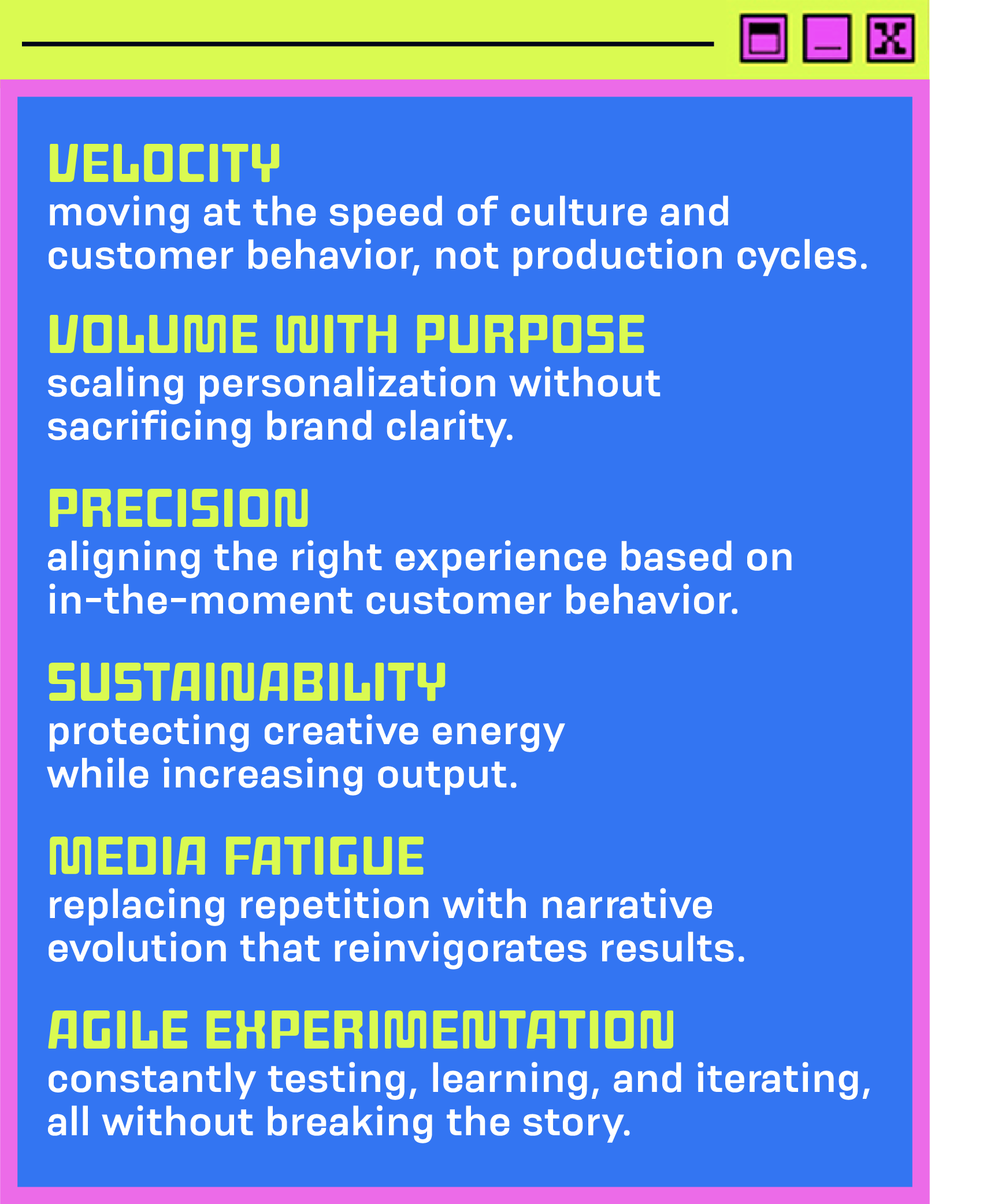
Intelligent story systems transform operations, allowing brands to move with agility, and will provide a solve for six of the biggest challenges marketers face today:

Crucially, this is about far more than efficiency. When creativity is supported by connected systems, teams can spend less time rebuilding assets and more time refining thinking. Better systems lead to better judgment, stronger creative choices, and more meaningful brand experiences.
To power this new operating model, marketers will have to pair the best of human imagination and craft with machine intelligence. This hybrid system can deliver scale without sacrificing the creative storytelling that connects with audiences. Fears around generic—or insensitive—content have rightly been in focus over the past year as AI has been integrated into creative workflows. But human-in-the-loop operational plans ensure the right level of subject matter expertise is driving machine-generated outputs.
And, with a strategy that uses AI to assist and scale rather than ideate and execute, brands can reduce repetitive, low-value work, allowing their creative teams to better use their time to go deeper on higher-value storytelling.
This integrated creative engine accelerates prototyping, versioning, and adaptation, enabling full-funnel effectiveness and opening up a team’s ability to shape culturally relevant, original storytelling.




Big catalyzing ideas require more than ambition to succeed. They require a system built to promote and support adaptability with precision and speed.
The process through which ideas move from brief to production to distribution and optimization is referred to as "the content supply chain,” historically a linear and siloed approach to content ecosystems.
But this traditional model tends to break down in a world where the traditional funnel has been completely obliterated—people jump between platforms, formats, and moments, making context more important than ever before.
To meet this moment, we can take our big catalyzing ideas and bring them to life through intelligent story systems: A connected approach that links creativity and media at the onset, allowing stories to adapt and evolve based on real-world signals.
They are adaptive to data, mapping customers' curiosity and branching natively into personalized, platform-specific assets that can take different shapes—from streaming pre-roll to creator collaborations on social to in-store retail experiences.
Intelligent story systems transform operations, allowing brands to move with agility, and will provide a solve for six of the biggest challenges marketers face today:
Crucially, this is about far more than efficiency. When creativity is supported by connected systems, teams can spend less time rebuilding assets and more time refining thinking. Better systems lead to better judgment, stronger creative choices, and more meaningful brand experiences.
To power this new operating model, marketers will have to pair the best of human imagination and craft with machine intelligence. This hybrid system can deliver scale without sacrificing the creative storytelling that connects with audiences. Fears around generic—or insensitive—content have rightly been in focus over the past year as AI has been integrated into creative workflows. But human-in-the-loop operational plans ensure the right level of subject matter expertise is driving machine-generated outputs.
And, with a strategy that uses AI to assist and scale rather than ideate and execute, brands can reduce repetitive, low-value work, allowing their creative teams to better use their time to go deeper on higher-value storytelling.
This integrated creative engine accelerates prototyping, versioning, and adaptation, enabling full-funnel effectiveness and opening up a team’s ability to shape culturally relevant, original storytelling.

Marketing leaders are overwhelmingly in favor of connected content operations, but many don’t know where to start.
In McKinsey’s “Connecting for Growth: A Makeover for Your Marketing Operating Model” report, 78% of CMOs surveyed agree that deploying a fully connected marketing strategy is important, but only 39% described their company as able to implement it, citing siloed setups and insufficient cross-functional collaboration as the primary obstacles.



Marketing leaders are overwhelmingly in favor of connected content operations, but many don’t know where to start.
In McKinsey’s “Connecting for Growth: A Makeover for Your Marketing Operating Model” report, 78% of CMOs surveyed agree that deploying a fully connected marketing strategy is important, but only 39% described their company as able to implement it, citing siloed setups and insufficient cross-functional collaboration as the primary obstacles.
A brand that has found success by implementing this new system in practice is Adobe, as the company’s marketing approach is shifting from isolated campaign bursts to a continuously orchestrated story system that adapts globally and locally.
Adobe tapped Dentsu Creative as its global agency partner to build a global creative engine to streamline product marketing content supporting Adobe’s creativity and productivity business.
Housing all creative within one unified story system, dentsu leveraged Adobe’s suite of industry-leading creative tools—from GenStudio to Photoshop Mobile to Adobe Express to Adobe Firefly—and built a global, full-funnel team of more than 300 specialists to deliver consistent, quality content across brand design, video, social, email, web, events, merchandise, and in-app experiences. The hybrid One dentsu creative team—including end-to-end production company, Tag—delivered over 440 projects, more than one project per weekday. This resulted in the creation of tens of thousands of frictionless global assets to drive business outcomes for Adobe.
The work shows what’s possible when human expertise and craft combine with AI-powered production to function in harmony, driving a better experience both for the in-house teams and the customer engaging across multiple touchpoints. When brands connect their content and media supply chains, they stop guessing what works and start proving it.



A brand that has found success by implementing this new system in practice is Adobe, as the company’s marketing approach is shifting from isolated campaign bursts to a continuously orchestrated story system that adapts globally and locally.

Adobe tapped Dentsu Creative as its global agency partner to build a global creative engine to streamline product marketing content supporting Adobe’s creativity and productivity business.
Housing all creative within one unified story system, dentsu leveraged Adobe’s suite of industry-leading creative tools—from GenStudio to Photoshop Mobile to Adobe Express to Adobe Firefly—and built a global, full-funnel team of more than 300 specialists to deliver consistent, quality content across brand design, video, social, email, web, events, merchandise, and in-app experiences. The hybrid One dentsu creative team—including end-to-end production company, Tag—delivered over 440 projects, more than one project per weekday. This resulted in the creation of tens of thousands of frictionless global assets to drive business outcomes for Adobe.

The work shows what’s possible when human expertise and craft combine with AI-powered production to function in harmony, driving a better experience both for the in-house teams and the customer engaging across multiple touchpoints. When brands connect their content and media supply chains, they stop guessing what works and start proving it.


As the media ecosystem continues to fragment, the brands that win will be those that operate connected systems. Unified storytellers will be able to move intelligently and with agility vs. competitors who remain siloed. And though there will always be talk about the latest tech innovations, the brands that succeed will not just be the early adopters, but the ones that create internal structures to best utilize them.

As marketers are witnessing declining ROI from paid digital and social media spend, it’s more critical than ever to recalibrate to the system that connects both media and creative.
This is where integrated platforms like dentsu.Connect can serve as connective infrastructure, enabling workflow orchestration across teams and markets that take advantage of the latest AI systems to amplify clients' unique value. Technology is the amplifier; creativity remains the differentiator.
The content supply chain isn’t about producing more things; it’s about connecting the things that matter. Human creativity remains the centerpiece of any winning marketing strategy—but it only has a chance to reach its full impact when there’s an optimized system in place to bring it to life.
This new era of marketing is moving beyond pushing messages outward; the work has become about predicting based on meaningful data, listening to what’s in the zeitgeist, and responding to create content that’s timely and relevant.
These creative executions are expected to drive emotional connection and brand loyalty. And they need to do so in an increasingly crowded space as attention becomes a true commodity.


As the media ecosystem continues to fragment, the brands that win will be those that operate connected systems. Unified storytellers will be able to move intelligently and with agility vs. competitors who remain siloed. And though there will always be talk about the latest tech innovations, the brands that succeed will not just be the early adopters, but the ones that create internal structures to best utilize them.
As marketers are witnessing declining ROI from paid digital and social media spend, it’s more critical than ever to recalibrate to the system that connects both media and creative.
This is where integrated platforms like dentsu.Connect can serve as connective infrastructure, enabling workflow orchestration across teams and markets that take advantage of the latest AI systems to amplify clients' unique value. Technology is the amplifier; creativity remains the differentiator.
The content supply chain isn’t about producing more things; it’s about connecting the things that matter. Human creativity remains the centerpiece of any winning marketing strategy—but it only has a chance to reach its full impact when there’s an optimized system in place to bring it to life.
This new era of marketing is moving beyond pushing messages outward; the work has become about predicting based on meaningful data, listening to what’s in the zeitgeist, and responding to create content that’s timely and relevant.
These creative executions are expected to drive emotional connection and brand loyalty. And they need to do so in an increasingly crowded space as attention becomes a true commodity.



Dentsu is an integrated growth and transformation partner to the world’s leading organizations. Founded in 1901 in Tokyo, Japan, and now present in approximately 120 countries and regions, it has a proven track record of nurturing and developing innovations, combining the talents of its global network of leadership brands to develop impactful and integrated growth solutions for clients. Dentsu delivers end-to-end experience transformation (EX) by integrating its services across media, customer experience management (CXM), and creative, while its business transformation (BX) mindset pushes the boundaries of transformation and sustainable growth for brands, people, and society.


Dentsu Creative is a global creative agency network designed to unlock exponential growth for clients. The agency network uses transformative creativity as a differentiating, driving force to bring its capabilities together to positively impact people, businesses, and society. Established in June 2022, Dentsu Creative is integrated with dentsu’s media and CXM businesses in over 145 countries and regions to offer end-to-end solutions to clients globally. Learn more here.


Illustrations by Lisett Ledón
Dentsu is an integrated growth and transformation partner to the world’s leading organizations. Founded in 1901 in Tokyo, Japan, and now present in approximately 120 countries and regions, it has a proven track record of nurturing and developing innovations, combining the talents of its global network of leadership brands to develop impactful and integrated growth solutions for clients. Dentsu delivers end-to-end experience transformation (EX) by integrating its services across media, customer experience management (CXM), and creative, while its business transformation (BX) mindset pushes the boundaries of transformation and sustainable growth for brands, people, and society.
Dentsu Creative is a global creative agency network designed to unlock exponential growth for clients. The agency network uses transformative creativity as a differentiating, driving force to bring its capabilities together to positively impact people, businesses, and society. Established in June 2022, Dentsu Creative is integrated with dentsu’s media and CXM businesses in over 145 countries and regions to offer end-to-end solutions to clients globally. Learn more here.
Illustrations by Lisett Ledón