Hello all,
You put a big smile on my face today. I checked your suggestions for topics I should write about and found “How to prioritize accessibility” right near the top of the list. It was so heartwarming.
For years it felt like few cared about accessibility. Management couldn’t see a return on investment; designers felt it ruined their designs, and developers believed it stopped them from building cutting-edge web apps.
Today things are different. Most of the designers and developers I meet understand its importance. However, it can still prove challenging to ensure it is prioritized when deadlines are pressing, and budgets are too small.
Fortunately, ensuring accessibility happens is easy… get management to insist on it. Then, if they want it, it will happen. Simple! Next question.
“Okay, okay. So I know the next question —”how do we get management to demand we prioritize accessibility?” Or put another way, “how do we make the case for accessibility?”
Well, that one is a bit trickier, but still possible.
There are two approaches I use in conjunction. First, I broaden the definition of accessibility, and second, I demonstrate that accessibility can provide business benefits they care about.
Broaden the definition of web accessibility
Most of us care about accessibility because we know we have a moral and legal obligation to meet the needs of those with access needs.
A case for accessibility has to be more than legal or moral
However, the moral and legal argument will only take you so far. Yes, meeting legal requirements is certainly a motivator at many organizations, but these will rarely be prioritized over profit.
As for moral obligations, few prioritize their morals when faced with pressing deadlines and targets.
Ultimately many leadership teams think (even if they do not say it out loud) that it doesn’t make sense to invest a lot of work catering to a relatively small audience.
Make a case for inclusive design rather than accessibility
However, suppose we adopt Microsoft’s approach to talk about inclusive design. In that case, accessibility starts to impact a much bigger segment of your organization’s user base and becomes a much higher priority.
Accessibility is no longer just about the needs of the disabled (a relatively small audience); it is about those with situational or temporary disabilities too.
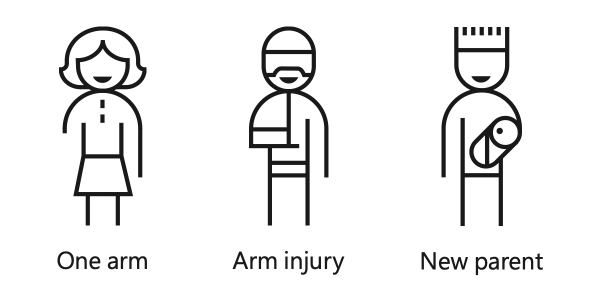
People with one arm may be a small audience. However, when you factor those in with broken or sprained arms, that grows considerably. Then, when you consider those with their other arm occupied (such as holding a child), accessibility suddenly helps every user.
Admittedly some of those within the accessibility community worry that inclusive design marginalizes the disabled, and I can see their point. However, taking this broad view of accessibility is an excellent way of demonstrating business value, which brings me to my second tactic.
Make a business case for accessibility
The approach I use when making a case for accessibility is essentially the same approach I make for promoting UX design. This approach boils down to finding out what management already cares about and demonstrating how accessibility can help.
You will be surprised just how helpful accessibility can be in achieving management goals.
- If management wants to increase traffic to your website, making that site accessible for screen readers will help with search engine rankings.
- If management wants users to remember more of their critical messaging, designing for those with cognitive disabilities will improve everybody’s comprehension and retention of information.
- If management wants more people to watch their videos, adding subtitles will improve viewership on social media.
- If management wants to increase online sales, making checkout forms accessible will help people order on mobile devices.
- If management wants to reach an older audience, increasing font size and contrast will help those like myself who have to wear reading glasses.
You get the idea.
There is not a single case for accessibility
I think the mistake is that we try to get management to buy into an overarching case for accessibility. However, that is a somewhat amorphous concept that can be hard to grasp. Even those who champion accessibility could not tell you all the WCAG guidelines (or is that just me)!
Instead, we should focus on promoting specific aspects of accessibility that solve specific business problems. Admittedly this isn’t all we ultimately want. However, it does start the ball rolling, and something is better than nothing.
But don’t stop there. The case for accessibility is not suddenly won. You will always need to push organizations to take it more and more seriously. I have focused on taking that first step, but there are many more after that, and for further help, I recommend AbilityNet’s case for accessibility.
“As the saying goes, “a journey of a thousand miles begins with a single step.”